Author

yewonk

Browsing

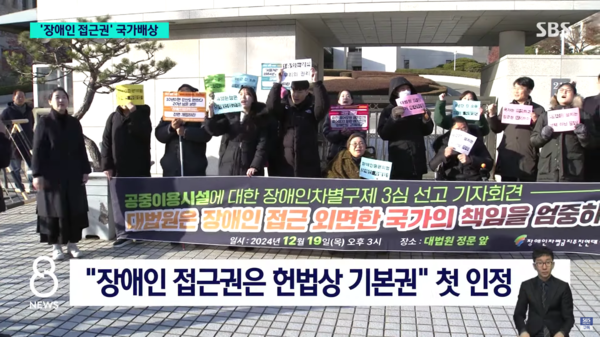
Not all rulings advanced rights: a notable “obstacle” decision by the Seoul High Court declined to treat derogatory remarks by members of the National Assembly as actionable insult or discrimination, reasoning the remarks were not directed at identifiable individuals and applying strict standards for ‘social evaluation’ harms. Disability advocates criticized this approach for effectively measuring discrimination by criminal-law thresholds and weakening the enforcement of anti-discrimination protections. The report underscores the need for continued strategic litigation and legislative or administrative reform to translate these judicial advances into broader, everyday accessibility and to counter rulings that limit the reach of anti-discrimination law.


Original source: [특집/2025년 장애인인권 디딤돌·걸림돌 판결] “장애인차별, 계속 부딪혀 장애인인권 디딤돌 판례 많이 만들어내야” (Source: the news outlet; please refer to the original article.)
The Korea Association of Welfare Facilities for the Disabled (한국장애인복지시설협회, HanJangHyeop) held a high-profile ethics pledge ceremony at its recent general meeting, attended by more than 350 facility directors. The event was organized in response to recent controversies involving some disability welfare facilities and aimed to correct public misperceptions by reaffirming the sincere dedication of frontline staff. Association president Kim Kwang-sik stressed the need to protect staff reputation and rebuild public trust through a clear, collective commitment to professional ethics.

The association’s ethics code, written into its bylaws, comprises 17 articles centered on protecting the dignity and rights of persons with disabilities and safeguarding staff rights. Key provisions include respect for dignity and self-determination, prohibition of discrimination across all human-rights domains, obligations to support community engagement, protection of employee professionalism and labor rights, and strict adherence to anti-corruption laws that bar seeking improper benefits.

At the ceremony directors read the full ethics code aloud and pledged strict compliance. The association declared it will follow up with practical measures — including education and support — to ensure the code is actively implemented in daily operations. Leaders said the pledge is intended to serve as a firm foundation for ethical, transparent management of disability welfare services and to restore confidence in the sector’s professional integrity.


Original source: 한국장애인복지시설협회, 350여 시설장과 윤리강령 서약식 개최… 장애인 인권 수호 다짐 (Source: the news outlet; please refer to the original article.)
Ulsan Gangbuk Education Support Office has formed the 2026 Gangbuk Disability Student Human Rights Support Team to strengthen protection and prevention of rights violations for students with disabilities. The initiative aims to activate on-the-ground support in schools and create safer, more inclusive learning environments that promote the well-being and happiness of disabled students.

The support team is composed of 17 regional experts led by the head of the elementary education division, including representatives from schools, the developmental disability support center, disability rights advocacy organizations, a parents’ association, a sexual violence counseling center, disability welfare services, and the local police. The group will conduct monthly visits to institutions across the area, carry out prevention and counseling activities, and prioritize protection of affected students. When rights violations occur, the team will provide immediate protection for victims and offer special support measures for both victims and involved students.

Officials held an appointment ceremony and coordination meeting on February 26 to discuss operational direction and detailed plans. Key agenda items included identifying “Thebom” students (those who have experienced or are at risk of rights violations), assigning roles to committee members, and building an integrated support system to diversify and improve effectiveness. The Gangbuk Education Support Office emphasized strengthening multi-agency, organic cooperation to ensure students’ rights are protected and to foster a culture of empathy toward disability in schools.


Original source: ≪케이에스피뉴스≫ 울산 강북교육지원청, 장애 학생 인권 보호 강화한다 (Source: the news outlet; please refer to the original article.)
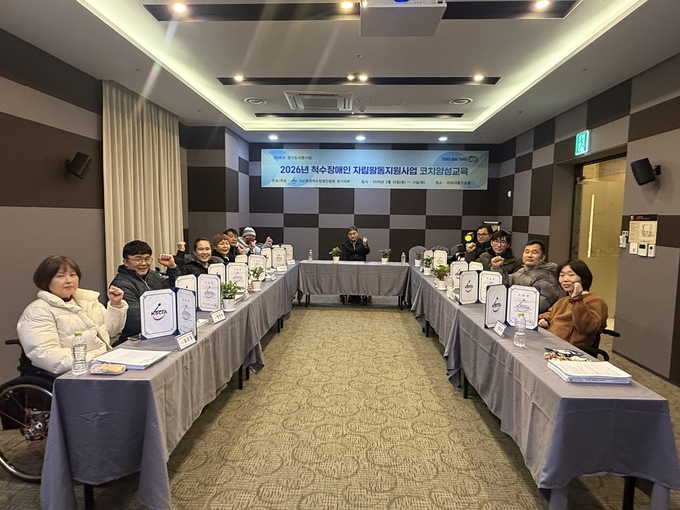
A specialized coach training program to support the independent living of people with spinal cord injuries was held at the Ramada Yongin Hotel from the 10th to the 12th of last month. Supported by Gyeonggi-do and hosted by the Korea Spinal Cord Injury Association (Gyeonggi branch), the annual course aims to cultivate professional staff who can help early-stage or socially isolated spinal cord injury patients return to community life.

Graduates of the program will provide one-on-one peer counseling, guidance on healthy acceptance of disability, daily living coaching, and information to promote social participation. These services are designed to lower trainees’ reliance on family members and personal aides, and to support them in leading more autonomous, self-directed lives.

Hello? from other side~

The practical, field-centered curriculum covered disability welfare policy, communication skills, disability rights, psychological stress management, and rehabilitation exercise, delivered by expert instructors. The association says the initiative will strengthen on-the-ground support for independence each year and expand practical systems to help reclusive and newly injured individuals reintegrate into society.


Original source: [용인신문] 척수장애인 자립지원 ‘코치양성교육’ (Source: the news outlet; please refer to the original article.)
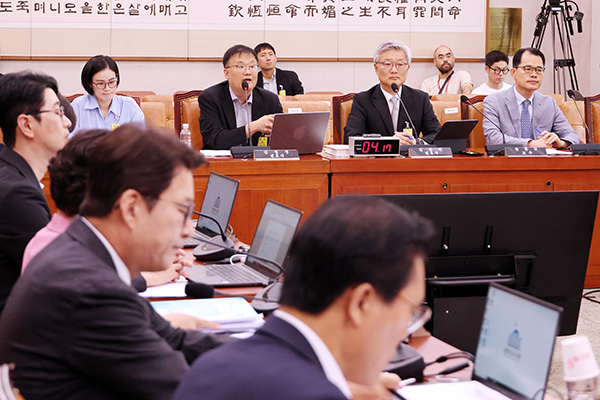
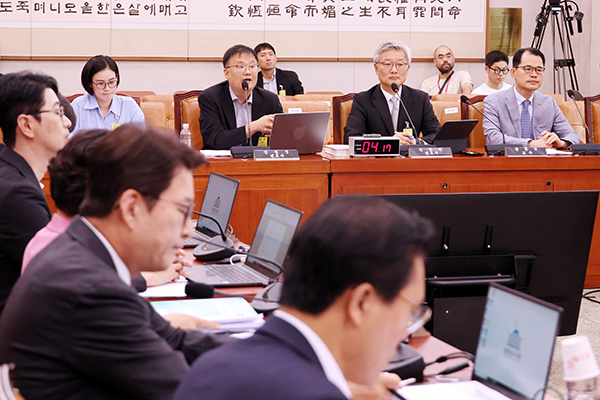
Lawmakers and legal experts convened at a National Assembly Judiciary Committee public hearing to review the Democratic Party’s so‑called “prosecutorial reform 4 laws” — abolishing the Prosecutor’s Office, creating a Public Prosecution Office, establishing a Serious Crimes Investigation Office, and founding a National Investigation Commission. While participants broadly agreed that prosecutorial reform is necessary, the hearing on March 9 revealed sharp disagreements over the bills’ design and potential consequences, with experts from the bar and academia offering deeply contrasting assessments.

Critics warned that dismantling the existing prosecutorial structure could produce serious side effects and weaken the quality of criminal prosecutions. They argued that wholesale abolition overlooks practical realities — for example, separating investigation and prosecution may prevent necessary supplementary investigations, complicate procedures, and ultimately harm vulnerable people. Several speakers also cautioned that political influence could simply shift from a “political prosecutor” to a “political police” if appointment and control powers remain with political actors, leaving the core problem of political intervention unresolved.

Supporters countered that meaningful change requires organizational overhaul: prosecutors must be stripped of direct investigative personnel and new, independent bodies should be created to oversee and request supplementary investigations and police conduct. Proponents framed the reforms as essential to restoring prosecutorial integrity and preventing past abuses. The committee agreed to refer the bills to a subcommittee for detailed review, underscoring consensus on the urgency of reform but no agreement yet on the best institutional path forward.


📌 원본 출처: www.lawtimes.co.kr

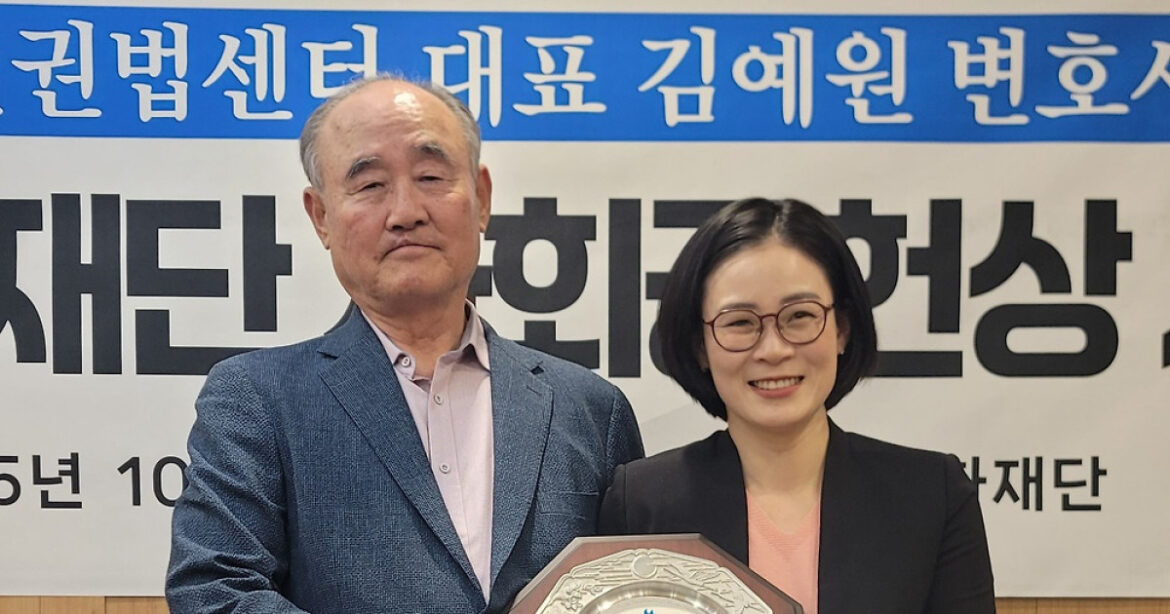
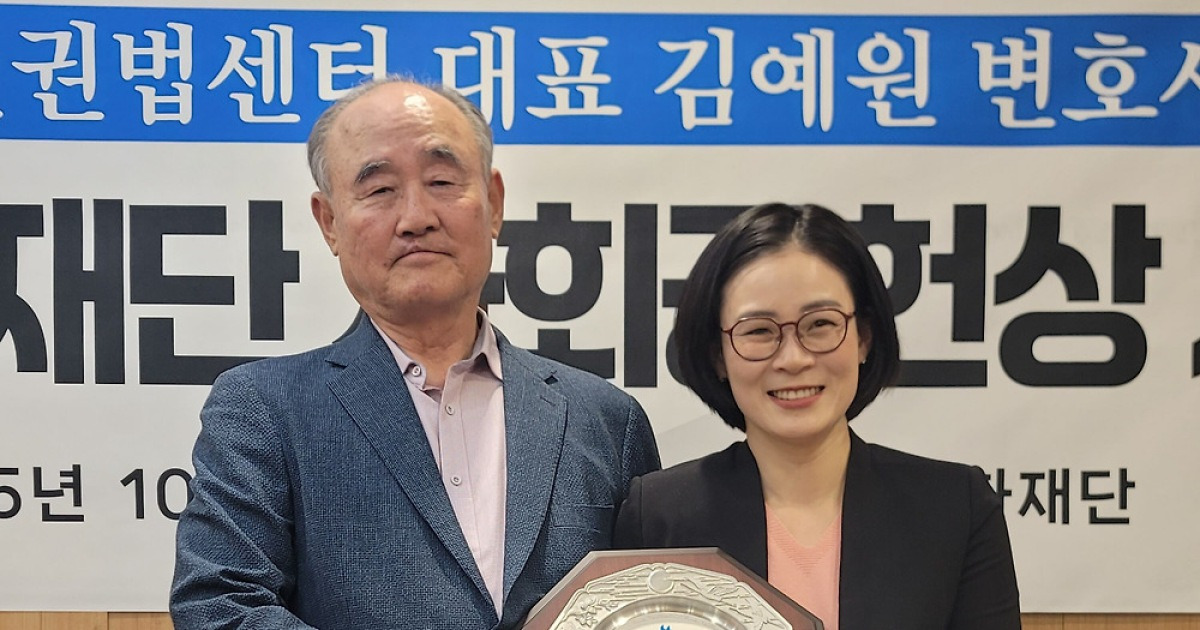
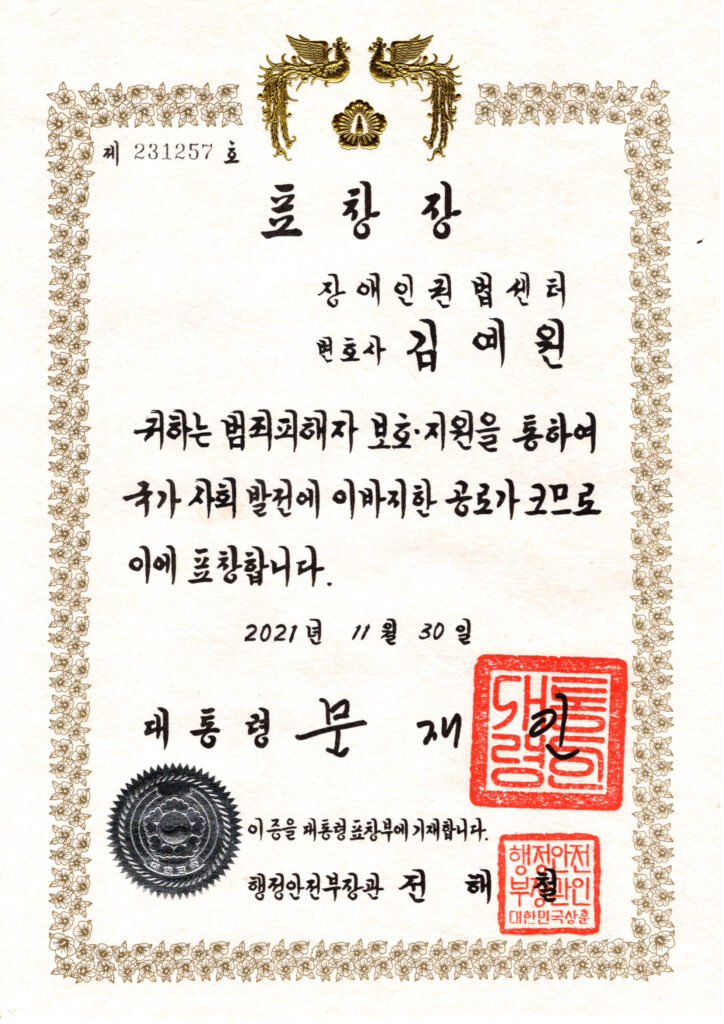
On October 24 at the Koreana Hotel in Seoul, attorney Kim Yewon, a visually impaired lawyer and head of the Disability Rights Law Center, received the Hyupseong Social Contribution Award. The prize, presented by Jeong Cheolwon, chairman of Hyupseong Comprehensive Construction and founder of the Hyupseong Cultural Foundation, carries a monetary award of ₩50 million. The foundation, established in 2010, supports social contribution and scholarship initiatives in Busan and beyond.

Kim has provided pro bono legal support for socially vulnerable groups—including women, children, people with disabilities, and migrants—focusing on public-interest litigation rather than financial gain. At the ceremony, Jeong praised her dedication to helping marginalized people and victims of crime, calling her a model legal professional who helps build a warmer society.

Accepting the award, Kim pledged to continue working humbly so that the voices of those who suffer are respected within institutions and society. The recognition underscores the importance of legal aid, disability rights advocacy, and the role of public-interest lawyers in advancing social justice and inclusion.


📌 원본 출처: v.daum.net

강원 평창군이 국립특수교육원이 주관하는 ‘장애인 평생학습도시’ 공모사업에서 3년 연속 선정되었습니다. 이로써 평창군은 2024년부터 2026년까지 장애인 평생교육 정책의 성과와 지속 가능성을 인정받으며, 국고보조금 2,550만 원을 지원받아 다양한 사업을 추진할 계획입니다.

평창군은 ‘장애인 평생교육 기회 확대를 위한 지역 네트워크 강화’를 목표로 설정하고, 장애인과 비장애인이 함께 참여하는 통합형 평생학습 프로그램을 운영할 예정입니다. 이를 위해 다양한 장애 유형을 고려한 맞춤형 교육과정을 편성하고, 가족을 대상으로 한 교육 프로그램도 함께 진행할 계획입니다.

또한, 장애인 인권에 대한 지역사회의 인식을 높이기 위해 장애 인권 강사 양성 과정을 운영하며, 수료자들은 지역 주민을 대상으로 교육을 실시하게 됩니다. 이현진 인재육성과장은 이러한 노력이 장애인과 비장애인이 함께 성장하는 평생학습 환경을 만드는 데 기여할 것이라고 밝혔습니다.


📌 원본 출처: www.eroun.net

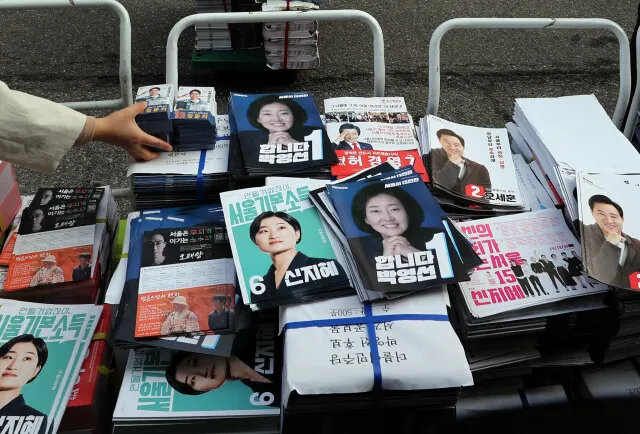
국가인권위원회가 중앙선거관리위원회와 방송미디어통신위원회에 점자 공보물 면수 제한을 폐지하고 수어 통역을 확대할 것을 권고했습니다. 이는 장애인 단체가 제기한 진정에 따른 것으로, 장애인의 실질적 참정권 보장을 위한 중요한 조치로 평가받고 있습니다.

장애인차별금지추진연대(장추련)는 이번 권고를 환영하면서도, 진정이 제기된 지 4년이 지나서야 이루어진 결정에 대해 아쉬움을 표현했습니다. 이들은 점자형 선거공보와 이해하기 쉬운 투표용지 제공 등을 통해 장애인들이 선거에 참여할 수 있는 권리를 보장해야 한다고 강조했습니다.

인권위의 권고는 중앙선관위가 법 개정을 통해 점자형 선거공보의 면수 제한을 없애고, 수어통역 확대를 위한 가이드라인 개정을 추진해야 한다는 내용을 담고 있습니다. 그러나 이 권고가 지연된 데 대한 비판이 제기되며, 장애인 단체들은 더 적극적인 제도 개선을 요구하고 있습니다.


📌 원본 출처: www.hani.co.kr

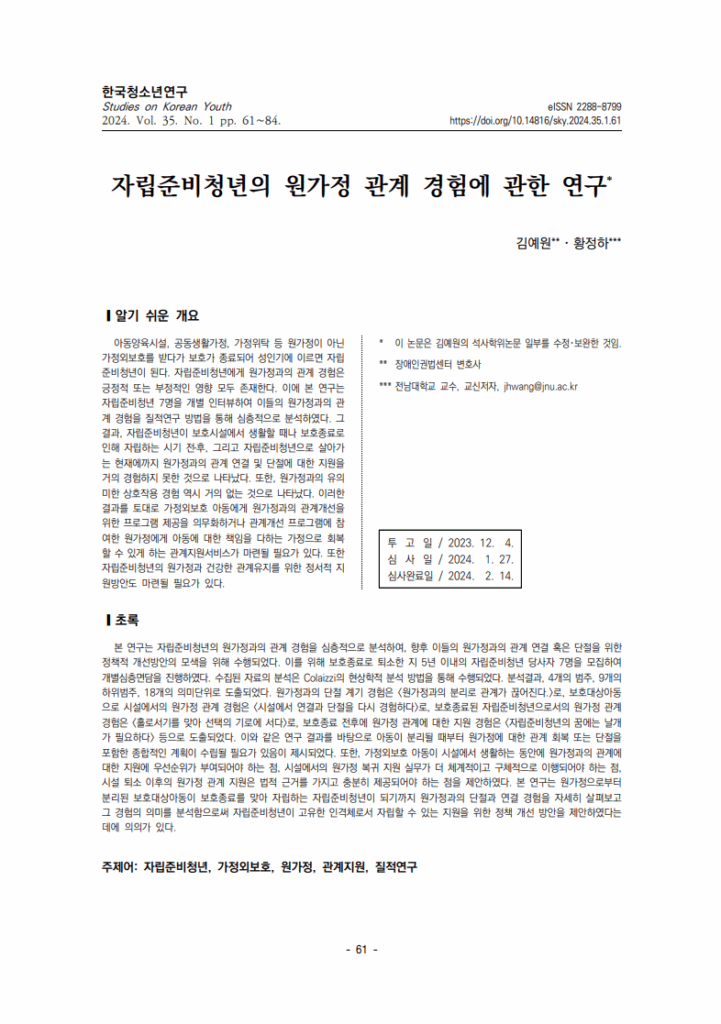
In 2024, DRAC conducted a study exploring how youth aging out of out-of-home care (YAOH) experience relationships with their families of origin. Through in-depth interviews with seven individuals who had exited protective care within the past five years, the study analyzed the emotional, social, and structural dynamics of maintaining—or letting go of—family ties. Using Colaizzi’s phenomenological method, the research identified key themes related to separation, reconnection, and the struggle for independence. The findings highlight the importance of early, consistent, and well-supported efforts to manage these relationships. Based on these insights, the study proposed policy improvements to help YAOH navigate family relationships in a way that supports their autonomy and long-term well-being.

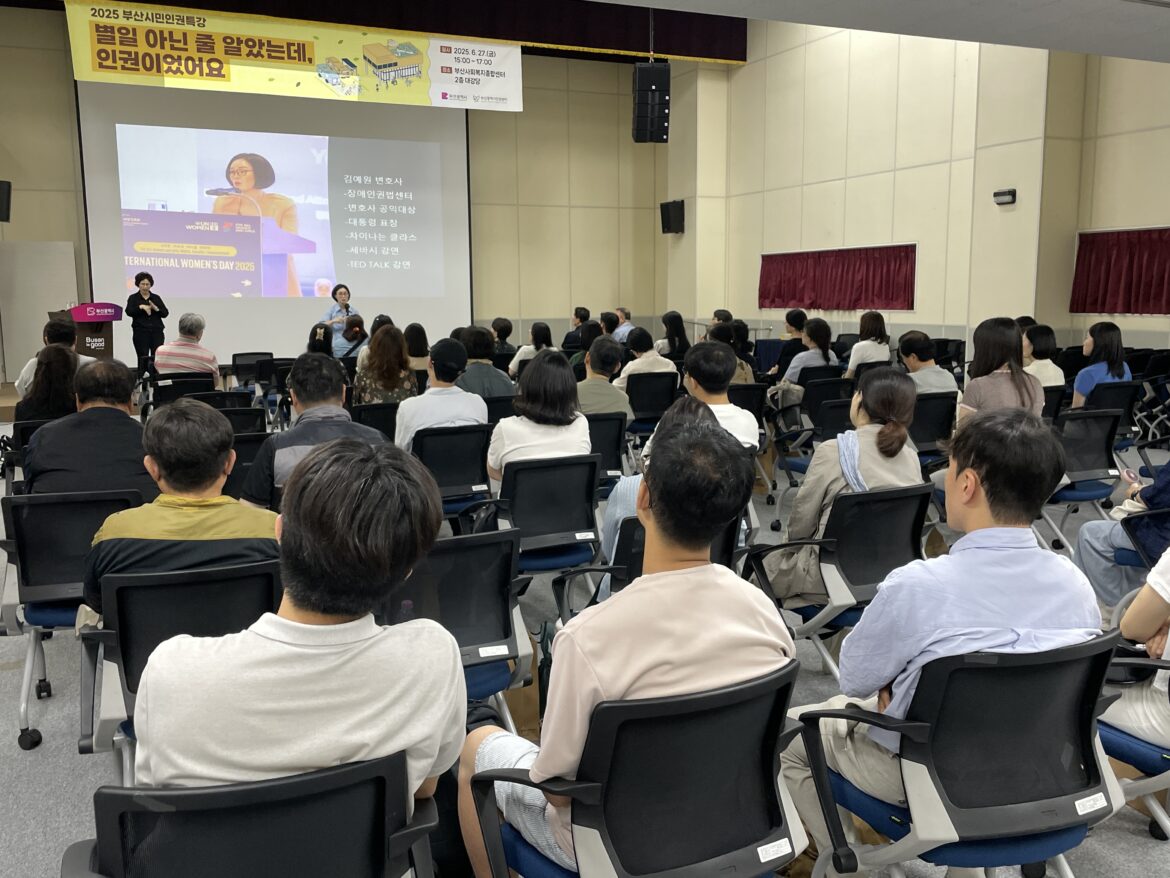
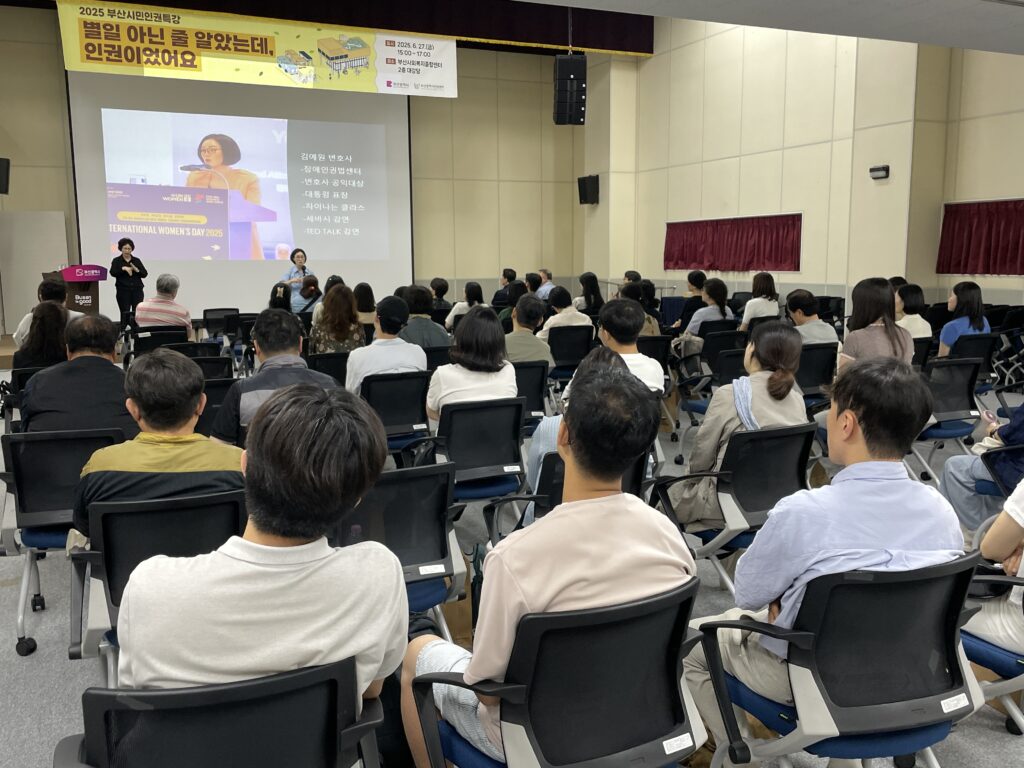
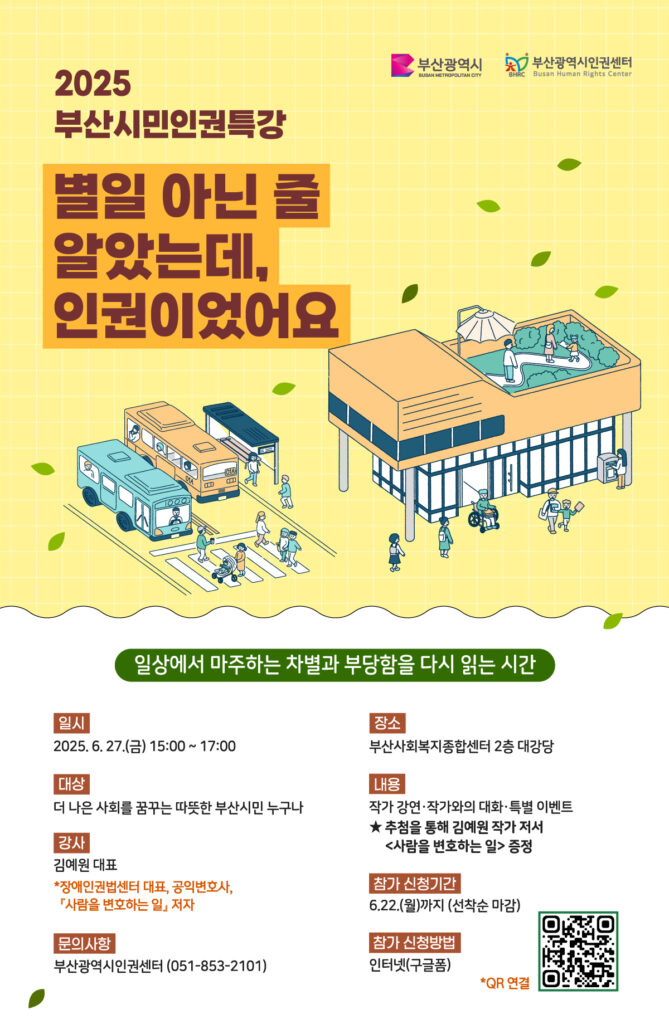
The Busan Human Rights Center, operated by the City of Busan, hosted a special human rights lecture featuring Yewon Kim, a lawyer and prominent human rights advocate, as the invited speaker.

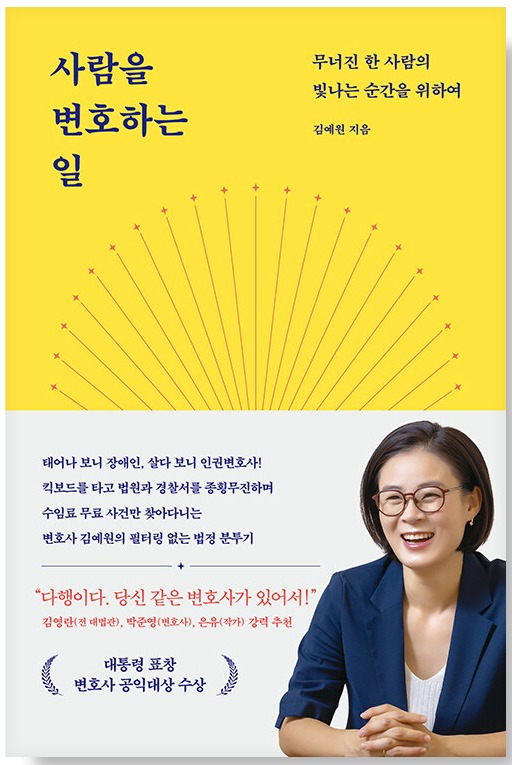
Held under the title “I Thought It Was Nothing, But It Was About Human Rights”, the lecture was part of Busan’s civic human rights education series. The talk was based on Kim’s notable work, Standing for Someone, which explores everyday injustices through the lens of human rights.

The event attracted a large audience of Busan citizens and concluded with a book signing session by the speaker. The lecture offered a meaningful opportunity for reflection and dialogue on the role of human rights in daily life, marking a significant moment in the city’s ongoing commitment to human rights awareness and education.

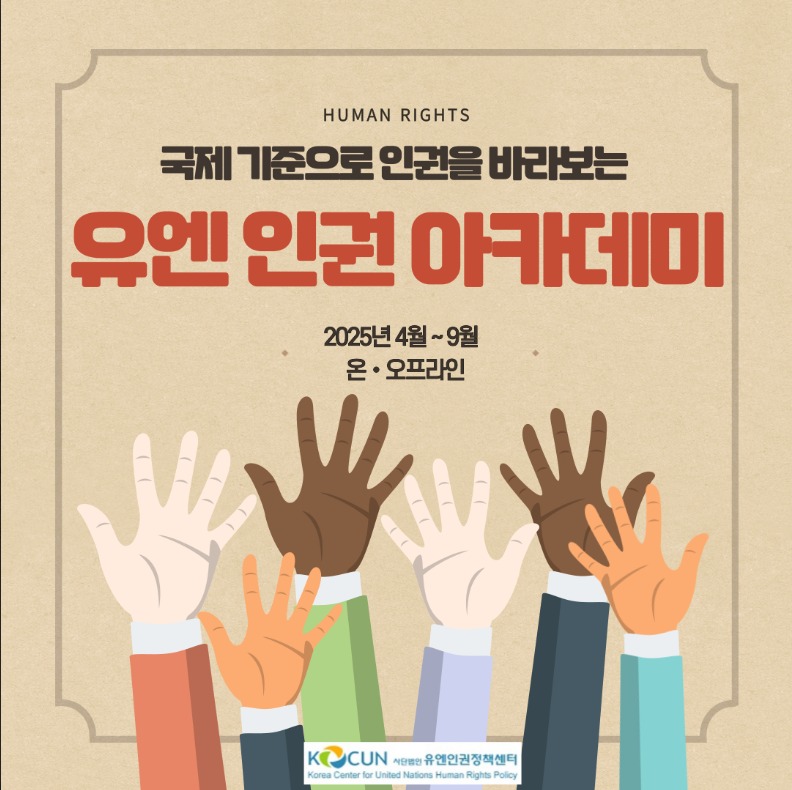
The UN Human Rights Academy, organized by the Korea Center for United Nations Human Rights Policy, is currently being held from April to September in both online and offline formats.

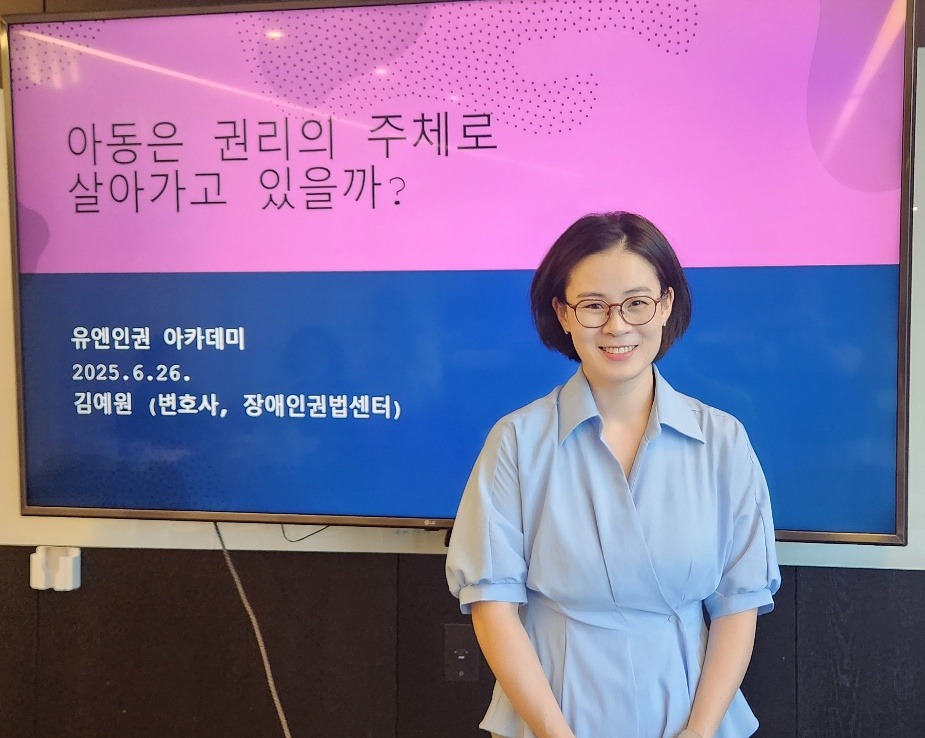
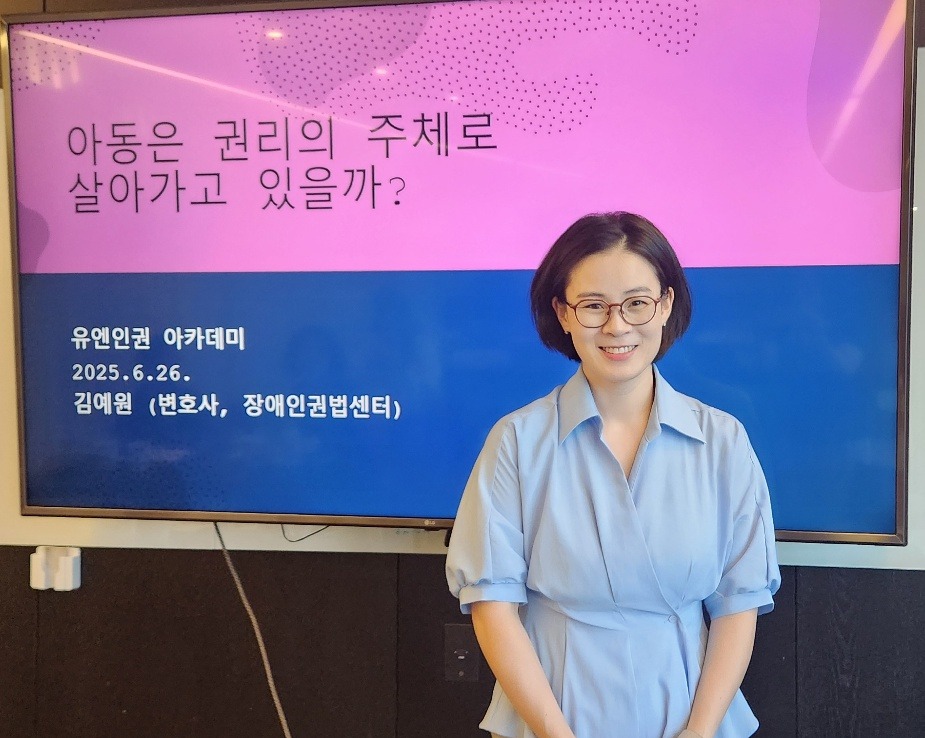
As part of the program, the fourth lecture took place in June under the title:
“Are Children Truly Recognized as Rights Holders?”
The session was led by Yewon Kim from DRAC (Disability Rights Advocacy Center), and featured in-depth discussions and active engagement from participants, reflecting significant interest in the topic.

In July, Yewon Kim will return as a speaker for the fifth lecture, titled:
“Persons with Disabilities and Non-disabled Persons – But What Matters Even More?”
The lecture will continue to examine fundamental human rights issues through expert insights and open dialogue.

The Academy remains committed to fostering public understanding and discourse on essential human rights themes.

“The One-Eyed Warrior Fighting Injustice”
Featured in Chosun Newspaper, South Korea’s leading national newspaper (2023)

In this feature by Chosun Newspaper, Attorney Yewon Kim discusses the deep flaws in South Korea’s child protection system, the unintended harm caused by poorly designed legal reforms, and her own journey as a public interest lawyer.

On child abuse: Kim criticizes the narrow focus on sensational cases, arguing that most abuse occurs within families and is often overlooked. She advocates for child-centered approaches that listen to the child’s voice rather than defaulting to institutional care or punishment. She shares heartbreaking cases where children suffered more from the system’s response than from the initial abuse.

On criminal justice reform: Kim voiced strong opposition to the 2022 law that removed investigative authority from prosecutors, arguing it makes it harder for victims—especially the most vulnerable—to access justice. She warned that the new system creates delays, confusion, and discourages reporting.

On challenging discrimination: Kim, who is blind in one eye due to a birth injury, led a successful seven-year legal effort to change Korea’s traffic law, allowing people with partial vision to obtain a Class 1 driver’s license. She also won a landmark Supreme Court case recognizing a prosthetic leg as part of the body for the purpose of workplace injury protection.

On her mission: Rather than framing her work as sacrifice, Kim emphasizes agency and purpose. She has handled over 1,000 cases representing people with disabilities, abuse survivors, and other marginalized individuals, stating:
“When society turns its back on the vulnerable, justice must be the one to hold the line.”

https://www.chosun.com/national/weekend/2022/10/29/6QHHBTT7KZEAZLOTZFUAADNKMM

“The Path Already Exists Within Me”
Featured in Law Times Korea (2022)

In her 2022 interview with Law Times Korea, Attorney Yewon Kim reflected on her quiet but persistent journey as a public interest lawyer. Rather than chasing visible success or recognition, she described her approach as steady and grounded—“like pedaling beneath the surface in a swan boat.”

Born with vision loss in one eye due to a medical accident, Kim attributes her deep sense of empathy not to hardship alone, but to growing up in a rural community where she naturally connected with people often overlooked by society. She emphasized the importance of surrounding herself with good people—mentors, communities, and colleagues—who inspired her to stay true to her values.

Since founding the Disability Rights Law Center in 2017, Kim has provided legal support to people with disabilities and other marginalized groups, choosing to work quietly, away from the spotlight. “Most of my cases never make the news,” she explained, “and that’s intentional.”

She has also spoken out against political inaction, particularly on disability rights, defending protest movements as demands for overdue justice—not unreasonable requests.

Now continuing her work as a visiting scholar at Duke University, Kim encourages young lawyers to begin where they are:
“Start with what moves you. Public interest work begins not with a grand mission, but with genuine attention and care.”

https://www.lawtimes.co.kr/opinion/179465

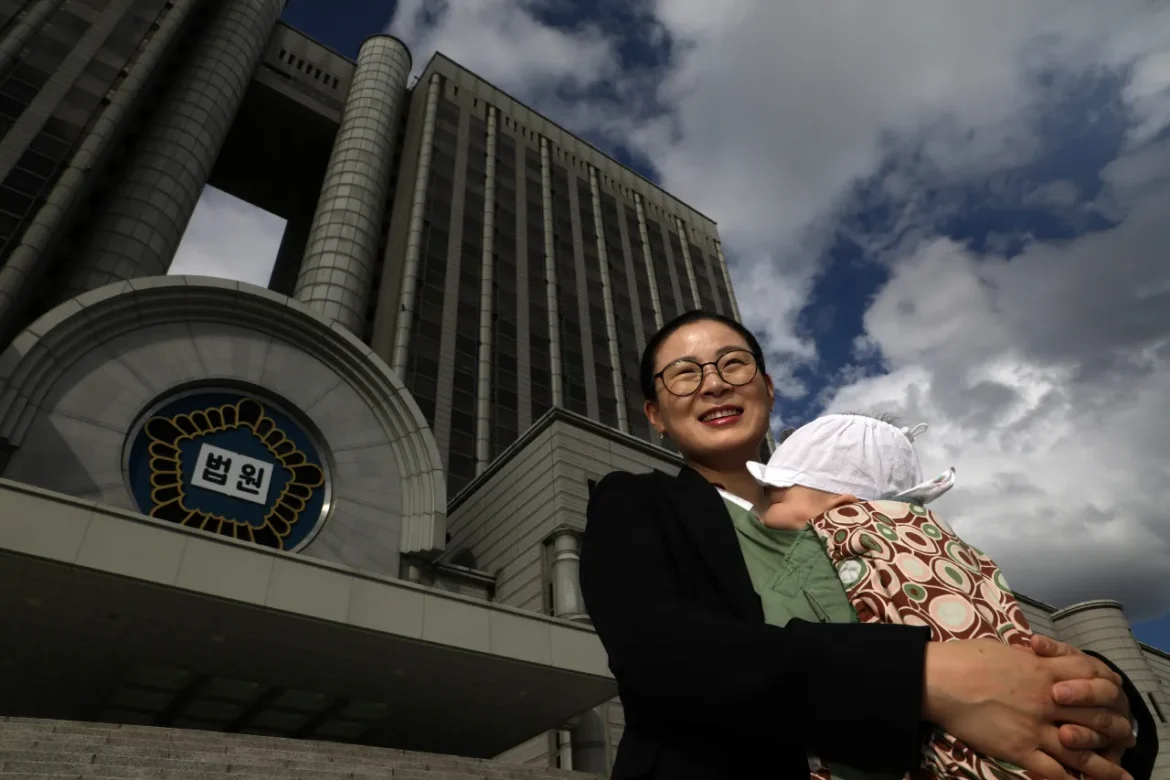
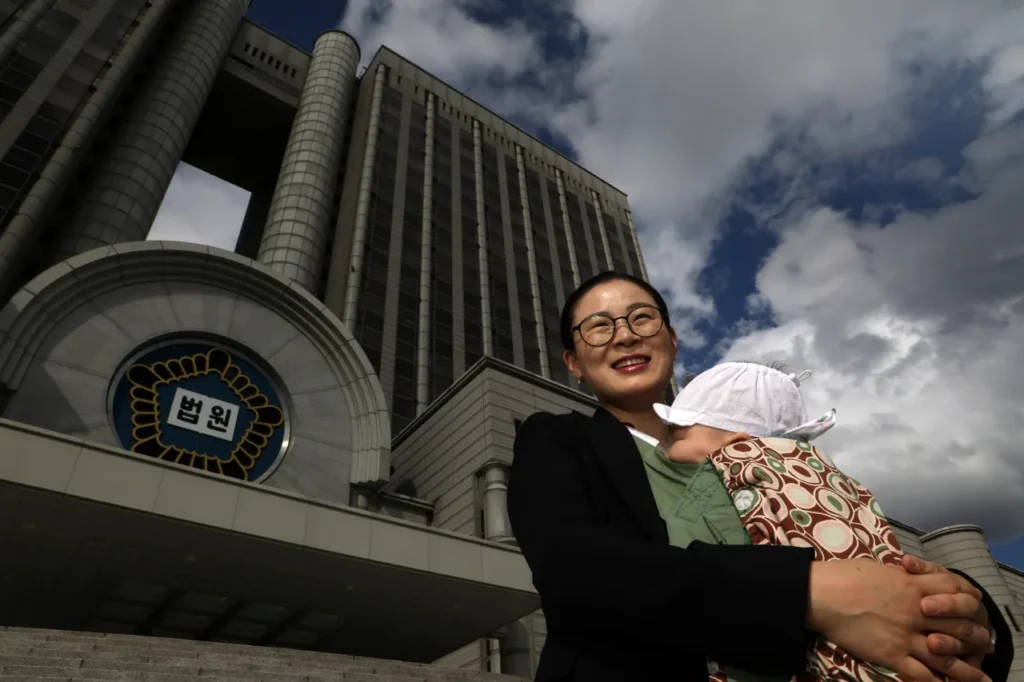
“Is it okay to breastfeed during a trial?” – “I don’t have time to worry about that.”
Featured in Kyunghyang Newspaper (2018)

Attorney Yewon Kim was profiled in Kyunghyang Newspaper for her lifelong dedication to public interest law and her personal journey as both a lawyer and a mother. Born with a visual disability due to a medical accident, she has devoted her career to advocating for people with disabilities, women, children, and other marginalized groups.

From founding the Disability Rights Law Center to representing victims in landmark human rights cases, Attorney Kim has combined legal advocacy with legislative reform and deep community engagement. Her work is driven by lived experience and a strong belief that justice must reach those without power or privilege. With over 1,000 cases handled, she continues to fight for a world where vulnerability is met with dignity, not silence. As she puts it:
“My work may seem small, but for the people I help, it can mean an entirely new life. That is enough reason for me to keep going.”

https://www.khan.co.kr/article/201810200600055

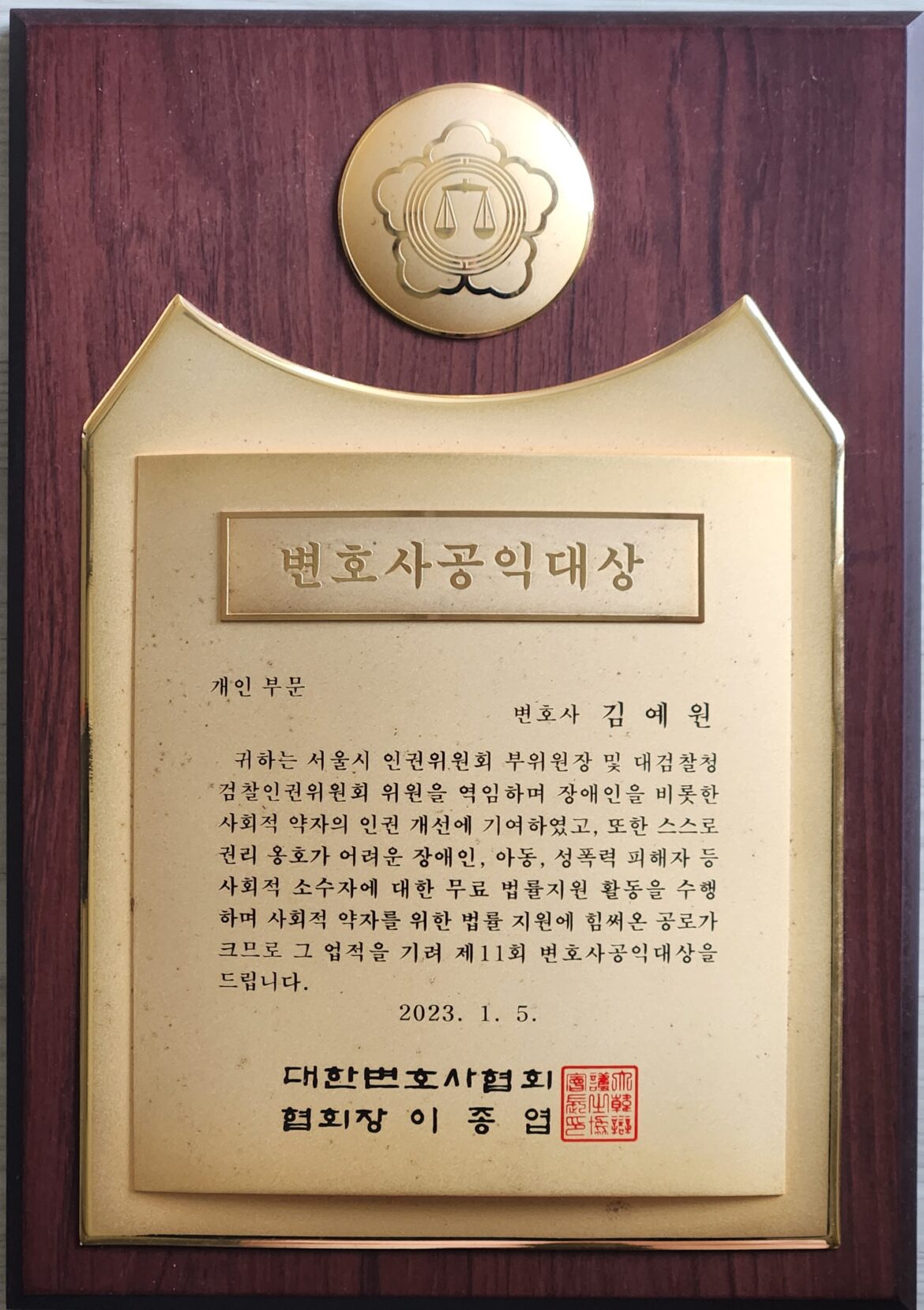
In 2023, Attorney Yewon Kim was honored with the Public Interest Lawyer Award by the Korean Bar Association. This prestigious award is given to only one individual or organization each year in recognition of exceptional contributions to human rights and the public good. Since beginning her legal career in 2012, Attorney Kim has devoted herself exclusively to public interest work—offering free legal representation to victims of abuse, discrimination, and violence, particularly those with disabilities. The award highlights her unwavering commitment to justice and social service.

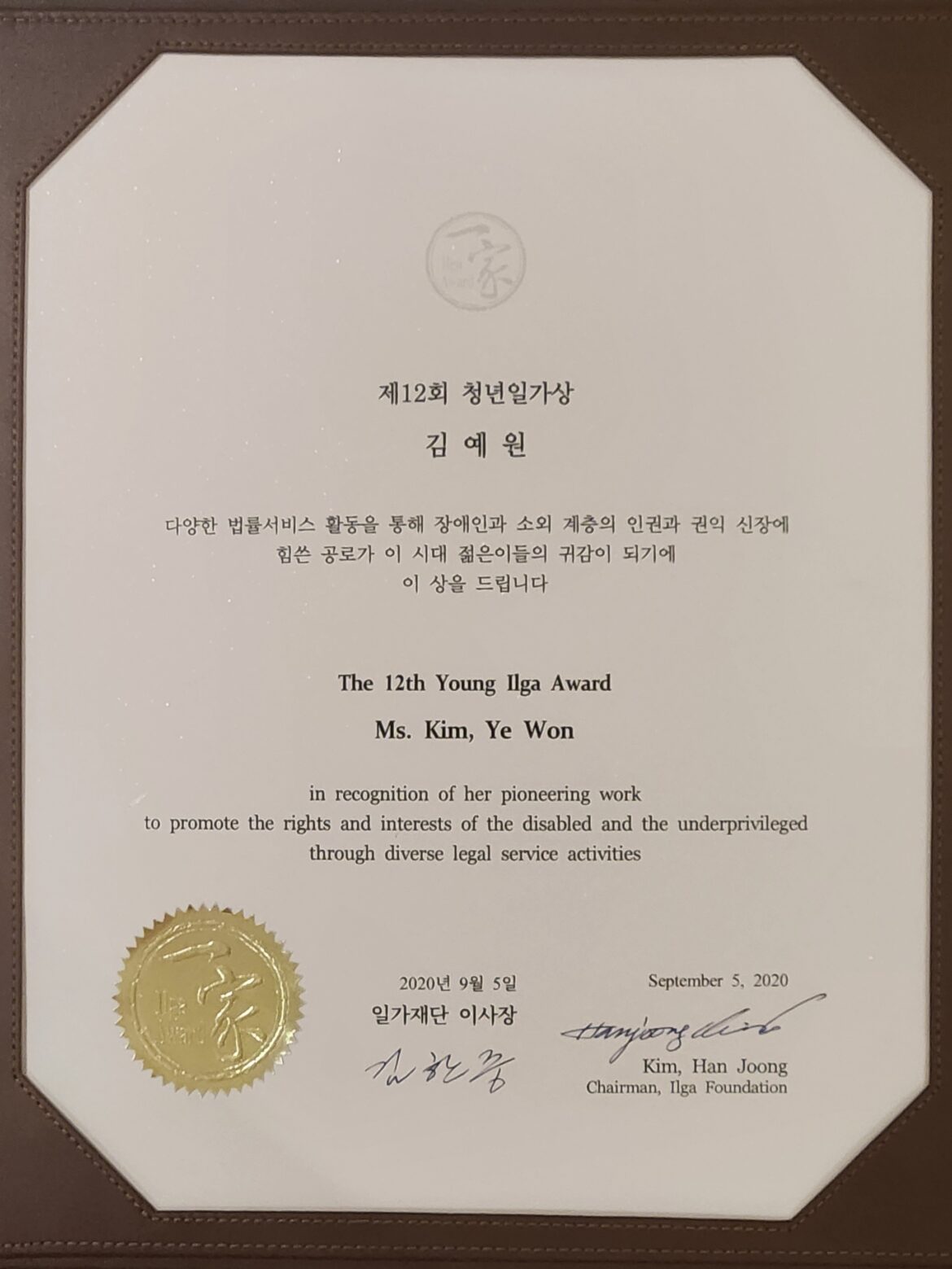
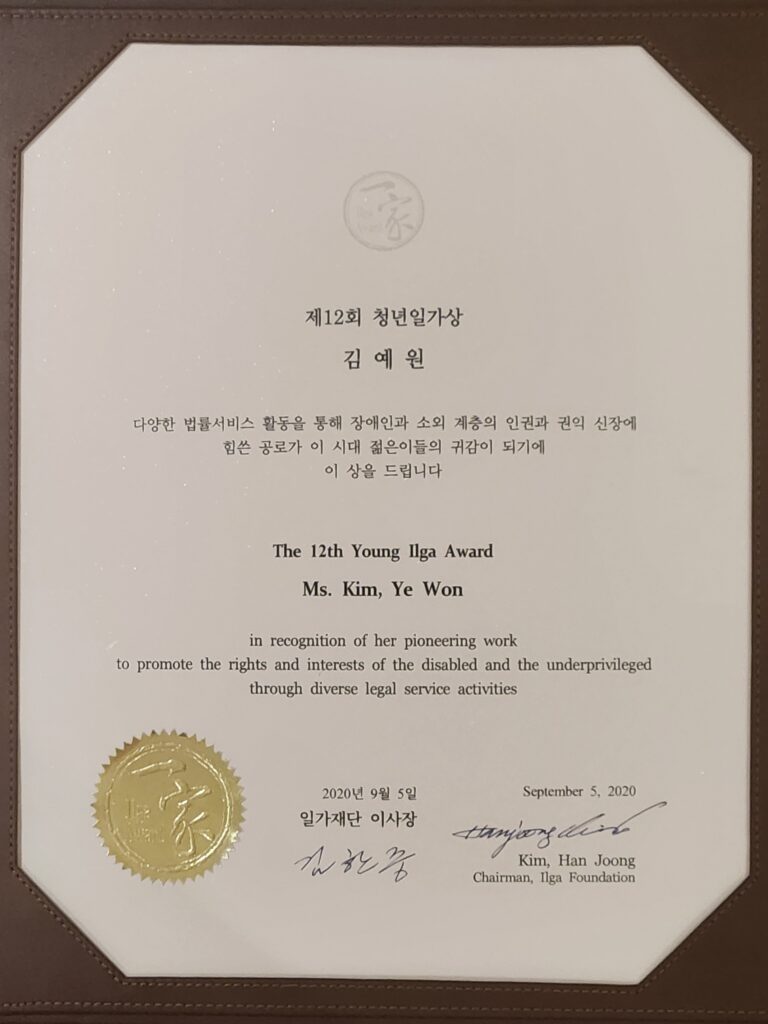
In 2020, Attorney Yewon Kim received the Youth Ilga Award from the Ilga Foundation, which recognizes young individuals who have made outstanding contributions to society. Born with a visual disability due to a medical accident, Attorney Kim has turned her lived experience into a lifelong commitment to justice. For over a decade, she has provided legal support to people with disabilities and other marginalized communities, using the law not only to resolve individual cases but also to drive systemic reform. Her work spans strategic litigation, legislative advocacy, and public interest law, resulting in meaningful legal precedents and improved protections for vulnerable populations. This award honored her efforts to expand human rights and social inclusion through compassionate and courageous legal practice.

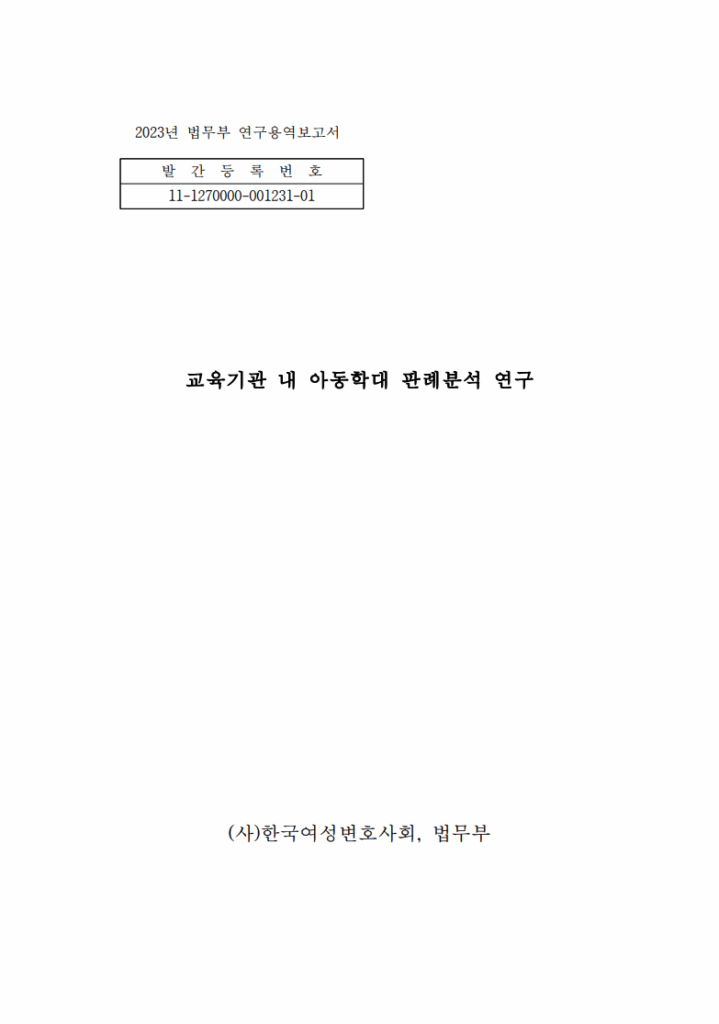
In 2023, under commission from the Ministry of Justice of the Republic of Korea, DRAC conducted an in-depth study analyzing over 300 court rulings related to child abuse cases involving educational personnel. The research focused on judgments from the past five years, especially those open to differing interpretations. By categorizing types of abuse and examining their causes and circumstances, the study offers valuable insights to inform future policies aimed at preventing and addressing child abuse in educational settings.

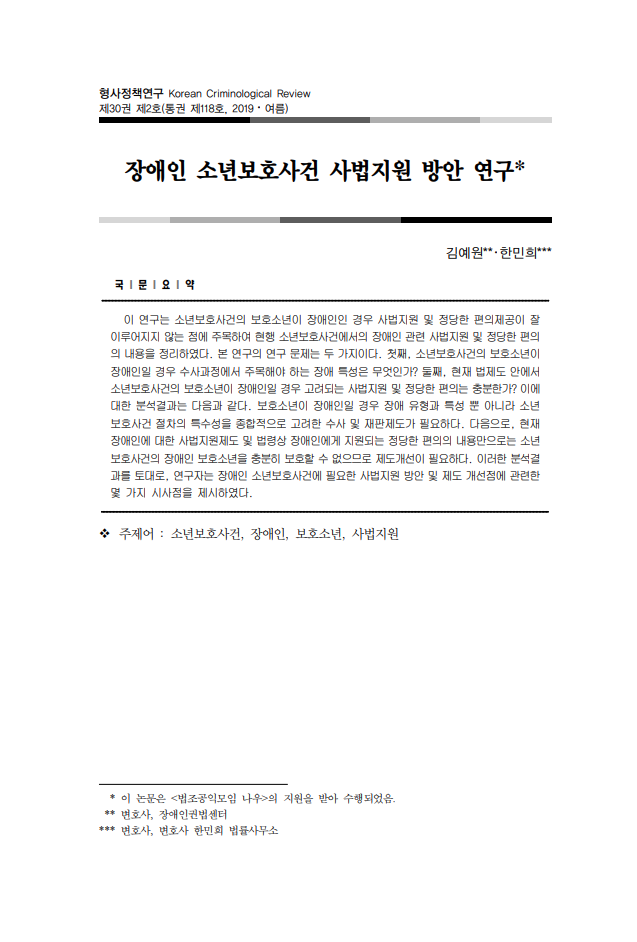
In 2019, DRAC conducted a study titled A Study of Schemes to Improve Juvenile Protection for Persons with Disabilities. The research examined whether juveniles with disabilities involved in protection proceedings receive sufficient legal support and reasonable accommodations. It revealed that existing procedures often fail to meet their specific needs and that the justice system must account more fully for both the characteristics of disabilities and the unique nature of juvenile protection cases. The study proposed practical measures to improve the fairness and effectiveness of judicial support for these vulnerable youths.